Texas Railroad History - Tower 59 - Waco
A Crossing of the San Antonio & Aransas Pass Railway and
the Missouri, Kansas & Texas Railway
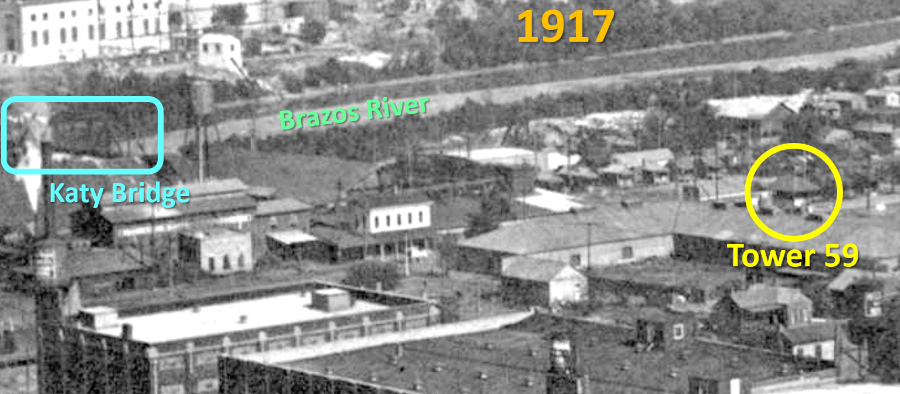 |
Left: This
image comes from a larger "bird's eye view" photograph of Waco taken
October 11, 1917. The photo captured a glimpse of Tower 59 in downtown Waco southwest of the Brazos
River, the best view of the tower found so far. The tower sat in the
south quadrant of an X-shaped crossing of the Missouri, Kansas & Texas
Railway and the San Antonio & Aransas Pass Railway
about 700 feet from the southwest end of the Katy's bridge over the
Brazos.
The photographer is undetermined. The photo was obtained by John Miller Morris (1952 - 2017) a professor and
historical geographer devoted to the collection and publication of
photographs and postcards from the first quarter of the 20th century.
The photo is part of a digital collection published by DeGolyer Library,
Southern Methodist University, the same library that houses the
interlocker archives of the Railroad Commission of Texas (RCT.) |
The Brazos River passes
through Waco on a northwest / southeast heading, with downtown located on the
southwest side of the river. The river's size and proclivity for flooding made
the Brazos a formidable obstacle for railroads. As such, railroads tended to
avoid crossing the Brazos unless absolutely necessary. When the Waco &
Northwestern (W&NW) Railway was completed between Waco and Bremond in
September, 1872, the tracks were laid into East
Waco, an unincorporated community of neighborhoods on the northeast
side of the river opposite downtown. The objective of the W&NW's predecessor,
the Waco Tap Railroad, had been to "tap" the Houston & Texas
Central (H&TC) Railway main line at Bremond, the nearest service point to
Waco. Coming out of Houston, the H&TC had avoided crossing the Brazos, remaining east of the
river, hence the W&NW did also. Negotiations ensued and the line from
Bremond to Waco was built for the W&NW by H&TC's construction forces. The W&NW
was acquired by the H&TC in 1873 to be operated as a subsidiary that would form
the initial segment of a lengthy route to the Texas panhandle.
The first railroad
to bridge the Brazos at Waco was the Missouri, Kansas & Texas (MK&T, "Katy")
Railway as it built a main line from Fort Worth to
Temple and beyond. The Katy, based in Kansas, was leased to Missouri Pacific (MP)
at the time; Katy President Jay Gould had decided MP would lead his
efforts to expand his empire into Texas. MP got the publicity, but since
it lacked a Texas railroad charter, the tracks were titled to the Katy
to comply with Texas' railroad ownership laws. [The Katy lacked one also but it had an 1870 Texas law
on its side that authorized it to build through the state from the Red
River to the Rio Grande; that was good enough for Gould.] Gould's reign over the Katy
ended when he was fired by its stockholders in 1888. When all of the
legal dust settled, the Katy was independent and operating its Texas
lines under a new Texas subsidiary headquartered in
Denison with a new railroad charter granted
by the Texas Legislature in October, 1891.
Right: The first MP
construction train to cross the river over the new bridge was reported
by the Waco Daily Examiner of
December 23, 1881. |
 |
 |
The San Antonio and
Aransas Pass (SA&AP) Railway was a long ways from Waco, but it decided to serve the area
to induce routing southbound export freight to the port of
Corpus Christi. The SA&AP had been chartered in 1884 by Uriah Lott to build
between San Antonio and
Corpus Christi, where
Lott had significant experience from his time directing construction of
the Corpus Christi, San Diego and Rio Grande Narrow Gauge Railroad.
With the
SA&AP having completed its San Antonio - Corpus Christi line in late 1886, its
objectives expanded to build from San Antonio to Kerrville in 1887 plus
additional branch lines in south Texas. In the 1887-1891 timeframe, the SA&AP
built a lengthy branch line from the small, south Texas town of Yoakum northward to Waco. Although it had entered receivership in 1890, the SA&AP was allowed by
the bankruptcy judge to finish the line to Waco, which occurred in October,
1891. The
tracks entered Waco on the southeast side of town and made a sweeping
curve to the northwest, paralleling the southwest bank of the Brazos into downtown
and crossing the Katy near the Brazos River bridge.
Around the time the
Waco branch opened, Southern
Pacific (SP) became interested in helping the
SA&AP out of bankruptcy. SP had acquired the H&TC in 1883, and it wanted to
acquire the SA&AP but was unable to do so due to Texas' railroad competition
laws. SP had a subsidiary, the
Galveston, Harrisburg and San Antonio (GH&SA) Railway, that competed
directly with the SA&AP in some markets, hence acquiring the SA&AP would be
unlawful. Instead, 80% of SA&AP stock was purchased by Pacific Improvement
Co. (PIC), a real estate holding company that also owned SP. To assist in
SA&AP's exit from bankruptcy, SP proposed to guarantee any new SA&AP construction bonds,
making them viable for sale on the New York bond market. SP's incentive was its
belief that it would benefit substantially from traffic generated by a healthy SA&AP in south
Texas. The bankruptcy judge agreed to the plan, and the bankruptcy ended in
1892. Unbeknownst to the judge, SP had planned to release several key employees
to be hired by SA&AP into its senior management ranks so that
it would function as a de facto subsidiary of SP.
In 1903, an investigation spurred by a tip
concerning documentation possessed by the Kentucky
Railroad Commission resulted in RCT claiming that SP had secretly and
unlawfully acquired control of the SA&AP by transferring PIC's stock
holdings to SP. RCT threatened to sue, but SP
admitted guilt and acquiesced to RCT's order to cancel its SA&AP stock (reducing
SA&AP's capitalization by 80%.) In exchange, RCT agreed to allow SA&AP to
retain its Texas railroad charter. SP was required to continue backing SA&AP bonds already
issued but it could not back new SA&AP bonds. The SA&AP became owned by the
holders of the remaining 20% of stock; all were heirs of Mifflin Kenedy who had
been one of the founding investors of the SA&AP. Though it maintained a close
working relationship with SP and its subsidiaries, SA&AP remained independent
for the next twenty years.
 |
In 1901, the Legislature gave RCT the authority to
regulate rail crossings. RCT responded immediately by mandating that all crossings be
gated until they were interlocked (a rule that was not always followed
or enforced.) RCT began issuing orders for railroads to
interlock specific crossings, subject to design and inspection approvals
by RCT's engineering staff. RCT limited the pace of orders so
that its staff could keep up with design review and
inspection duties for multiple interlocker projects.
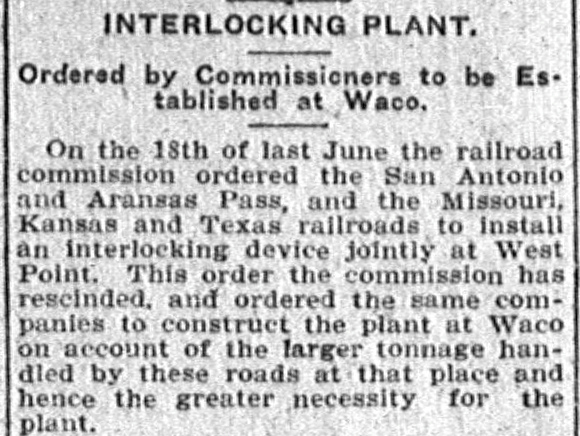
Left: The
Austin Statesman of February 9,
1904 reported that RCT had rescinded an order to interlock the
SA&AP / Katy crossing at West Point and
replaced it with an order to interlock the crossing of the same two
railroads at their intersection south of the Katy's bridge in downtown Waco. RCT could have simply issued an
interlocking order for Waco without regard to the West Point order (or
perhaps lengthened the schedule for West Point.) It did not do so,
most likely to limit the number of simultaneous interlocking projects to
a manageable level, both for its staff and those of the railroads
involved.
The SA&AP tracks out of Waco went south through West Point into south Texas. It's doubtful that it interchanged much traffic south of
Waco although it did cross other railroads at
various places (e.g. Cameron,
Rockdale, Giddings.) The Katy's tracks south
of Waco
eventually curved east toward Houston,
crossing the SA&AP at West Point. A sizable percentage of Katy freight
never reached West Point because instead of Houston, the freight was bound for
San Antonio or Laredo, either via Smithville / San Marcos
or an International & Great Northern Railroad (I&GN) connection at
Taylor.
Hence the
tonnage at the Katy / SA&AP crossing in Waco was greater than at West Point. |
To control the Katy / SA&AP crossing
at Waco, Tower 59 was commissioned by RCT on November 21, 1904. Tower 59 first
appears in RCT's annual interlocker reports in a table dated October 31, 1905.
The table lists Tower 59 as a mechanical interlocking plant having a capacity of
twenty levers of which eighteen were in use to control twenty functions. Unusual
among these annual reports, the 1905 table also had an Installed by
column showing that the Katy railroad had done the installation. About one-third
of the Installed by entries were railroads; the other two-thirds were
companies that manufactured interlocking plants. Only three of the 61 entries
were Installed by the Katy, the other two being
Tower 58 and Tower 61.
Those towers have a similar appearance, so it's very likely that Tower 59
resembled them (images of Tower 59 found thus far are inadequate to make a
direct comparison.)
In late 1916, RCT's annual report began to include
identification of the railroad responsible for each tower's operations. For Tower 59, it was the Katy,
no surprise since the Katy had installed the interlocking plant. By then, the plant's function count had
risen to 27. RCT's annual report issued at the end of 1923 lowered the function
count to 26 and it remained at that level for each subsequent annual report
through the end of 1929.
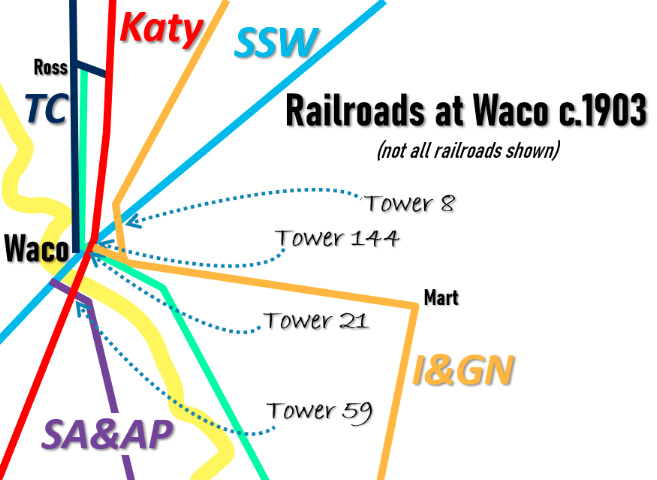
Right:
Waco area railroads c.1903; the Brazos River is depicted by the yellow
line
The St. Louis Southwestern (SSW, "Cotton Belt")
Railway had a line through Waco built in the 1880s that went
northeast to Texarkana and southwest to
Gatesville. In East Waco, it intersected an I&GN
line to Fort Worth; RCT commissioned
Tower 8 for the crossing in June, 1903. The
I&GN built a spur for passenger service to Waco Union Station via the
Cotton Belt's Brazos River bridge. The W&NW had been built on the best
right-of-way between Marlin and Waco, so
the I&GN's Marlin - Waco route went via Mart. The I&GN line between
Spring (near Houston) and Fort Worth was
completed in 1903.
Tower 21 was the main interlocking tower in
East Waco located at a junction of all of the steam railroads (the
electric interurban at Waco did not pass through Tower 21.) The junction
was just north of the Katy's bridge over the Brazos River.
Tower 144
was a ground lever interlocker -- a lever on a semi-circular switch
stand -- that controlled signals and derails for the Cotton Belt's
crossing of the Katy southwest of the Cotton Belt yard. The proximity to
the yard meant that Cotton Belt trains were moving slowly when they
approached the interlocker, hence the delay for a train crewmember to operate
the lever was not significant and a manned tower could not be justified.
The lever was
normally positioned to allow unrestricted movements on the Katy tracks.
The lever would be temporarily reversed to allow Cotton Belt trains to
cross and then reversed back to the normal position to permit unrestricted movements
on the Katy tracks.
The Texas Central (TC) had tracks from Waco to
Albany. It became a Katy property in 1914. |
 |

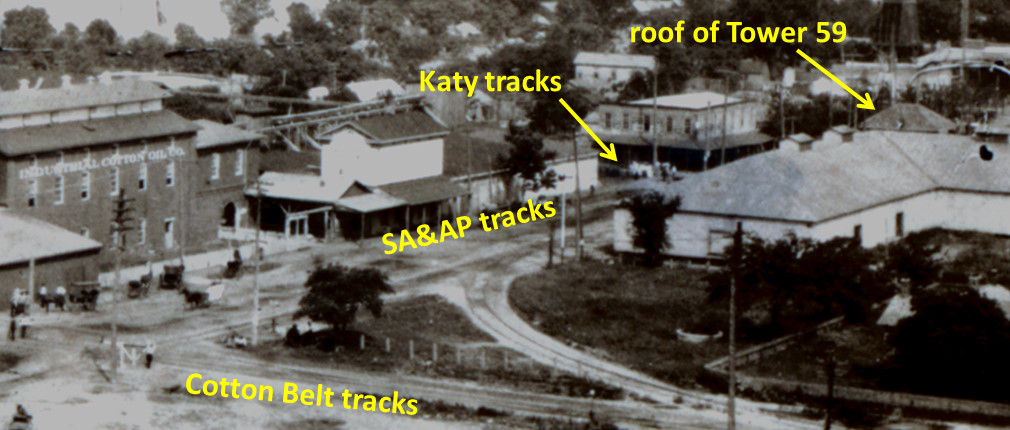
Above: The high
resolution version of this panoramic
photo of the Brazos River flood of 1908...
Right: ...shows the
rooftop of Tower 59 along the far right side of the image. The tower's roof profile
was very common among Texas interlocking towers.
In addition to
the Katy and SA&AP tracks, the Cotton Belt had tracks in downtown Waco that intersected the SA&AP in
the lower left corner of the image (known as "Brazos Junction.") The
Cotton Belt crossed the river on its own
bridge, off the image to the left. (Baylor University Libraries, hat tip, Dennis Hogan) |
 |
| Right:
RCT's interlocker table of December 31, 1930 omitted Tower 59 due to its
functions having been merged (via remote operation) into
Tower 21 across the river in East Waco. |
 |
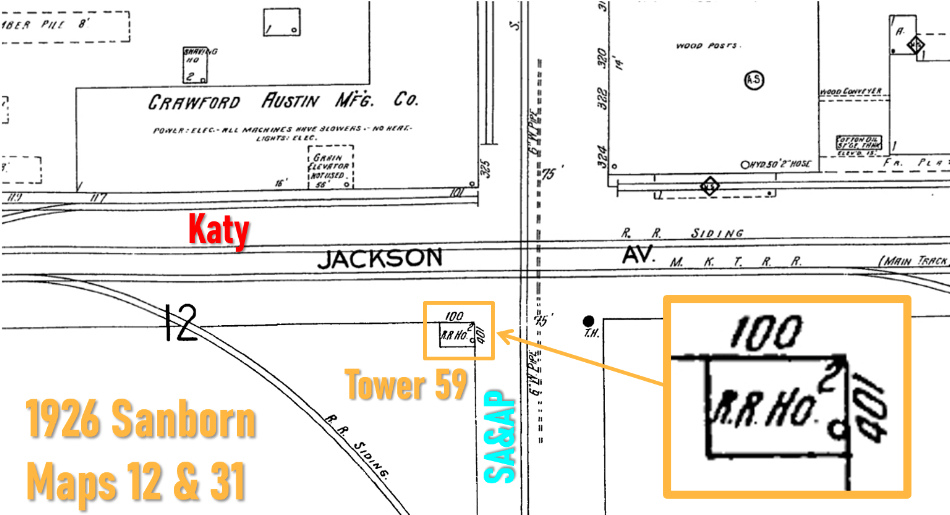 |
Left: This
graphic is an amalgamation of map numbers 12 and 31 from Volume 1 of the 1926
Sanborn Fire Insurance Co. map set of Waco. The tower location is along
an edge where the two maps overlap, but the tower appears only on map 31. The map
is angled about 45 degrees causing the "up" direction to be northwest.
The orange
inset annotation shows that the cartographer identified Tower 59 as a
"R.R.Ho." (Railroad House.) The '2' indicates a two-story building and
the circle in the lower right corner is the location of the door. Stairs
are not illustrated, but Sanborn maps were not consistent in depicting
exterior stairs. Some maps did (e.g. Towers 9
and 41) and some maps did not though the exterior stairs are known
to have existed (e.g. Tower 16.) It is
possible but unlikely that the stairs for Tower 59 were inside the building.
The numerals on two sides of the tower are probably street numbers
for those blocks. The Katy tracks ran along Jackson Avenue and the SA&AP
tracks used South 1st Street. |
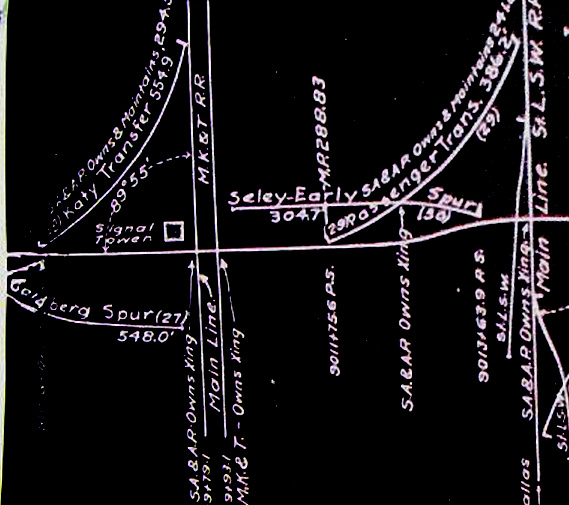 |
Left: This
snippet from a larger track chart of downtown Waco dated November 23,
1918 is oriented with southwest as the "up" direction. It depicts Tower 59
as a Signal Tower in the south quadrant of the SA&AP / Katy
crossing. The Katy had two tracks past the tower -- the main line and a
siding -- and the map notes that the diamonds had different owners,
presumably for
maintenance purposes. Behind (south
of) the tower, a "Katy Transfer" track provided a connection for
interchange.
Farther west, the SA&AP crossed the "St. L. S. W." (Cotton Belt.)
The "Passenger Trans." track in the south quadrant enabled SA&AP trains
to reach Waco Union Station, the depot built in 1907 for Cotton Belt,
SA&AP and I&GN use. A T&NO Employee Timetable (ETT) dated December 28,
1930 notes that the motor cars operating between Waco and Bremond were
also using Waco Union Station, so SP eventually consolidated its
passenger operations there.
The track chart image was provided by Bradley
Linda in an email dated September 16, 2005 wherein Bradley explained
that he and his father...
...went down to Temple this evening to set up the NMRA booth at the
Temple Train Show. We got done, and I started wandering the hall. I
found my timetable source there, and laying on his table were, for $8 a
copy, copies of a "Side Track Record" of the SA&AP between Adel and
Waco. I've attached the photo of one of the two pages on Waco. It shows
a "Signal Tower" at the MKT / SA&AP diamond (an 89 degree, 55 minute
crossing.)
Prior to Bradley's discovery, it was an
open question as to whether Tower 59 truly existed as an identifiable
building or was perhaps a cabin interlocker. Five days earlier, he and
his Dad had reviewed aerial imagery in the basement of Waco City Hall
but had come up empty. |
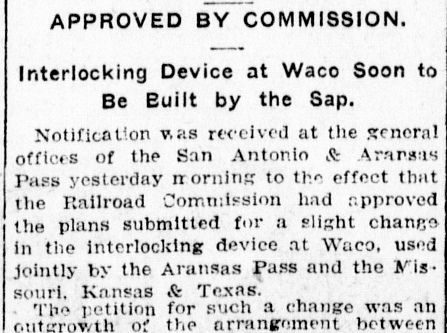
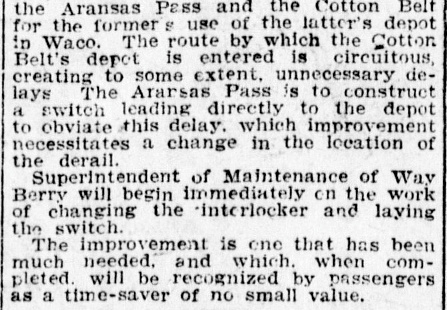
| Right:
The San Antonio Daily Express
of October 10, 1906 carried this news item (with a misleading headline)
about a change to the Tower 59 interlocking. It was a modification to
relocate (or perhaps remove) a derail that would interfere with a new
switch to be installed on the SA&AP tracks. The switch was for the new transfer track
(see track chart above) to enable SA&AP trains to go directly to the
new Waco Union Station. The article notes that SA&AP trains had been
using a "circuitous" route to reach
the Cotton Belt depot (located next to where the new station was being built.)
This is probably referencing SA&AP trains
needing to completely cross the Cotton Belt at Brazos Junction and then back
up onto the Cotton Belt bridge using a transfer track in the north
quadrant. Trains would then go southwest on the Cotton Belt to reach the
depot. |
 |
 |
Right:
Sometime in the 1930s, railroad executive John W Barriger III took
this photo from the rear platform of his business car as his train
proceeded south through Waco. Barriger's view is northeast along the
Katy tracks with the Brazos River bridge in the distance. The site of
Tower 59 was to the right, approximately where the car is parked; the
tower had been removed c.1930. The double tracks
past the tower site were illustrated on the 1918 track chart. To the
left, there is a car traveling northwest on S. 1st St. which hosted the
SA&AP tracks.
Below: At the far left edge (green circle) of this undated color postcard, Tower 59
(magnified below right)
is barely visible. (Dan Whatley collection )

 |
 |
In the Transportation
Act of 1920, Congress directed the Interstate Commerce Commission (ICC)
to promote and plan consolidation of U.S. railroads into a limited number of
"systems". The ICC responded by hiring economist William Z. Ripley to develop a
plan. The so-called Ripley Plan proposed that SP head one of these
systems and that the SA&AP become part of it. Although the Ripley Plan was never
formally implemented, the authority of the ICC to regulate interstate railroads
granted by the Act overrode the power of state railroad commissions. On December
6, 1924, SP applied to the ICC for permission to obtain financial control of the
SA&AP. The State of Texas opposed the move, but the ICC granted SP's
application. In March, 1925, the SA&AP was acquired by SP and leased to GH&SA.
In 1927, GH&SA was leased to the Texas & New Orleans (T&NO) Railroad
and subsequently merged in 1934. This was part of SP's move to consolidate all
of its Texas and Louisiana lines into the T&NO and it resulted in the
dissolution of the GH&SA and SA&AP corporations. The Cotton Belt was
acquired by SP in 1932 but it was not merged into the T&NO. In November,
1961, SP fully merged the T&NO; the T&NO subsidiary corporation was dissolved.
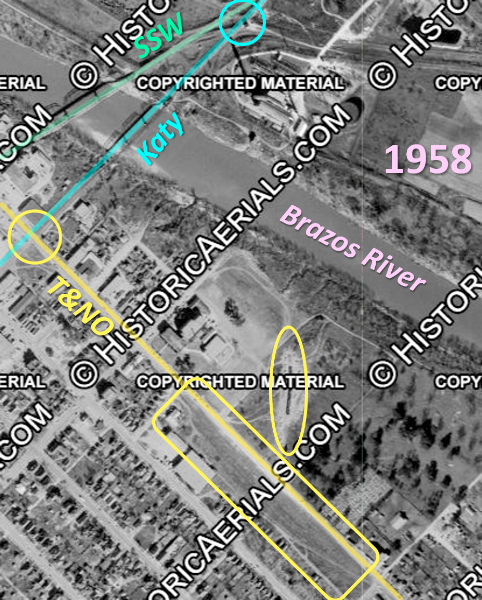 |
Left:
This 1958 image ((c) historicaerials.com) has been annotated to show the
north end of T&NO's Cameron Subdivision (yellow line), formerly the
SA&AP. The Tower 59 crossing (yellow circle) was an X-pattern; an
exchange track is visible in the south quadrant just below the circle. The SA&AP had built
a freight yard (yellow rectangle) on the approach to downtown, and its
freight depot is depicted there on Sanborn Fire Insurance maps. A
northward spur (yellow oval) led to a 60 ft. turntable in the early
years. Later, after T&NO abandoned SA&AP's yard, the area was referenced on
T&NO ETTs as "Waco Siding".
The T&NO freight yard
(inherited from H&TC) was east of Tower 21 on the Waco Subdivision to
Bremond, across the river from the Cameron Subdivision. This presented a
problem for trains coming north from Cameron as there was no direct way
to proceed across the river. Perhaps they delivered freight to Waco Siding and let switchers
from the yard fetch it. For northbound Cameron Subdivision freight
trains to cross the Cotton Belt bridge, use of the south connector at
Brazos Jct. and a run-around move on the Cotton Belt would have been
required. Whether this was ever done (or even feasible) is undetermined.
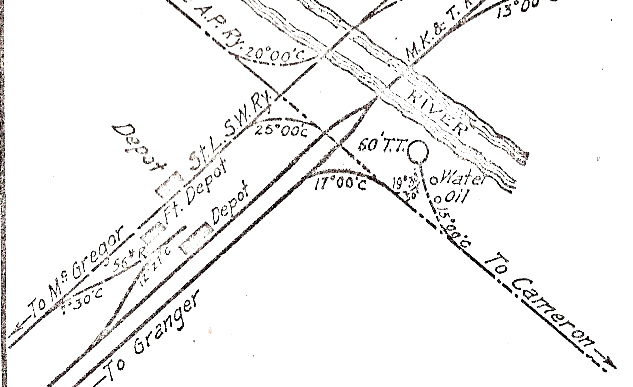 Left: This snippet from a 1915 Katy track chart (not
drawn to scale) shows the two crossings the SA&AP had in downtown Waco:
the Katy ("M.K.&T.") at Tower 59 and the SSW ("St.L.SW. Ry.")
at Brazos Jct., both with south quadrant connectors. Brazos Jct. also
had one in the north quadrant which was probably the means by which
SA&AP trains reached the Cotton Belt depot using a backup move prior to the south quadrant
connector being built. Note the 60 ft. turntable at the SA&AP yard area
near Tower 59 for Cameron Sub. power to turn around. |
T&NO abandoned the former
SA&AP tracks between Giddings and Cameron in 1959. South of Giddings, the
original SA&AP
tracks remained intact (as they are today) as part of the Dalsa Cutoff
between Hearne and Flatonia.
T&NO operations between Cameron and Waco continued, with T&NO accessing Cameron from Caldwell (on
the Dalsa Cutoff roughly midway between Hearne and
Giddings) using trackage rights on the Gulf, Colorado & Santa Fe Railway.
In 1967, SP abandoned the Cameron Subdivision between Waco and Rosebud, a tiny town
fifteen miles north of Cameron. Much of the right-of-way in Waco was repurposed
to carry streets and boulevards. The tracks between Rosebud and Cameron
functioned as a lengthy
business spur served from Cameron by SP trains out of Caldwell. In 1977, the
tracks were abandoned from Rosebud south to Quinif, a location on the northern
outskirts of Cameron which SP continued to serve with the Caldwell switcher. Seven
years later, SP sold the Cameron - Quinif track segment to Santa Fe and
it remains in service today by Santa Fe's successor, Burlington Northern
Santa Fe.
In 1965, SP
abandoned its route between Bremond and Waco; this had been the first rail line into Waco
(albeit East Waco.) MP proceeded to buy SP's tracks
on this line between Marlin and Waco because MP's
route between those towns (inherited from its 1925 acquisition of the I&GN) was
significantly longer and slower. The Bremond - Waco
abandonment eliminated the remainder of SP's former T&NO operations at Waco. In the 1980s, the
Cotton Belt's Waco
- Corsicana line was abandoned and the tracks west of Waco were sold off or
abandoned. The Cotton Belt bridge over the Brazos continues to stand though it
is long out of
service. The Cotton Belt remained a subsidiary of SP until 1992 when it became fully merged. In 1996, SP and
Union Pacific (UP) merged, with UP as the surviving corporation. The Katy
was acquired by UP in 1989. Its tracks through Waco remain intact and see
significant traffic.
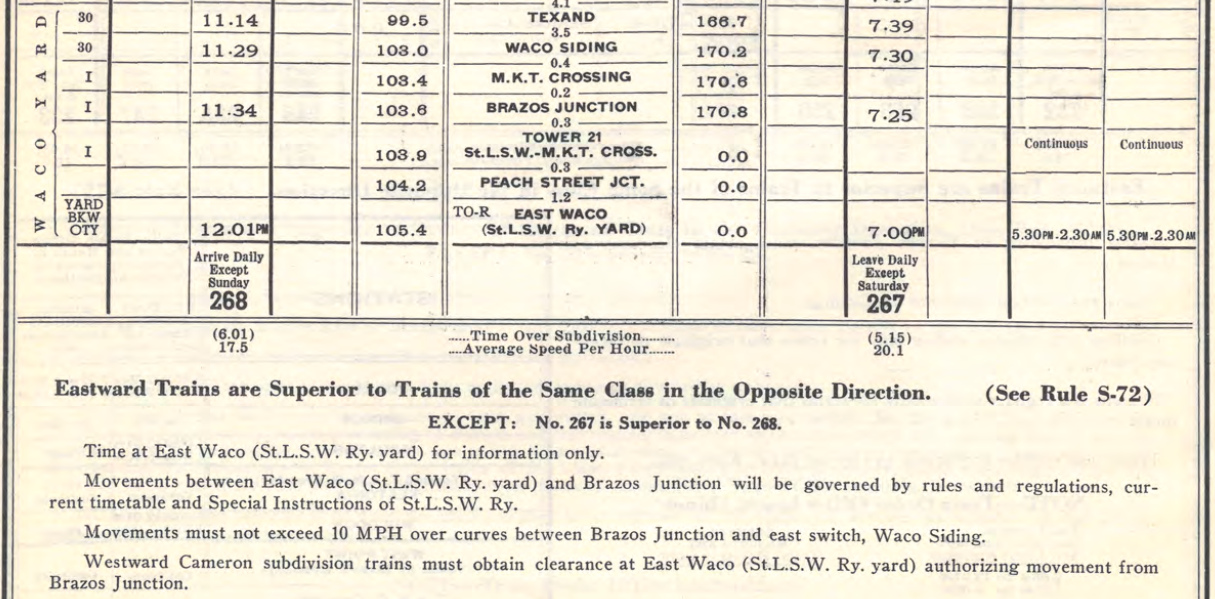
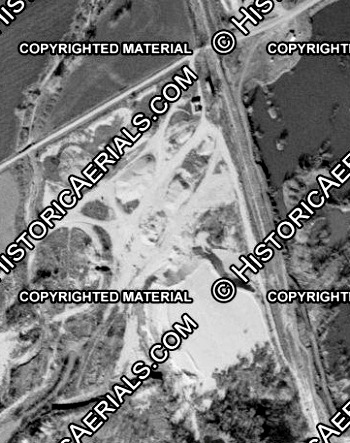
Above Left: This snippet of a
T&NO ETT dated June 29, 1952 shows the timetable into Waco from Texand at
Milepost 166.7. Texand (above right,
1958 (c) historicaerial.com) was a sand and gravel operation on the outskirts of
Waco (the site still looks like one; no longer rail-served it sits along the
west side of S. University Parks Dr. about 0.4 miles south of the Hwy. 6
underpass.) The "M.K.T. Crossing" entry on the ETT is the Tower 59 crossing -- the
tower was long gone by 1952. Note that the next station beyond Brazos Jct. was
Tower 21, i.e. the ETT assumed a northbound movement across the river on the
Cotton Belt bridge, even though it would require some sort of backup move on a
connecting track at Brazos Junction. The last three station entries are listed
with "0.0" milepost numbers because they were on the Cotton Belt line,
not the T&NO.
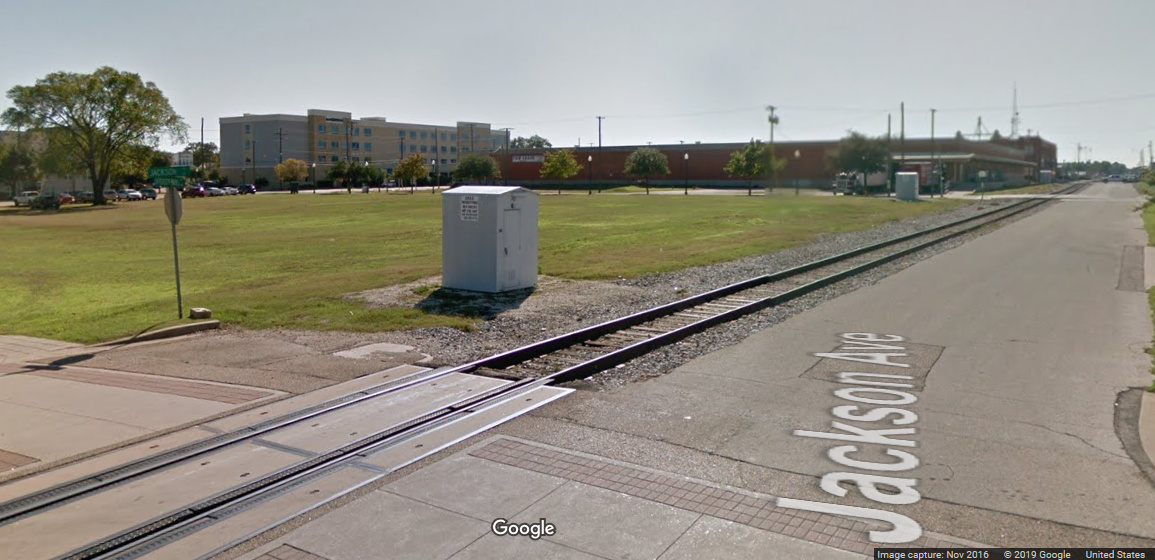 |
Left: This
Google Street View image from 2016 shows an open green-space with a
railroad signal control cabinet where Tower 59 once stood. This is now
the UP main line but the siding that was formerly adjacent to the tower
site no longer exists.
The cross street intersecting Jackson Ave.
is now S. University Parks Dr. and Google Street View imagery from 2025
shows that the green-space is now entirely occupied by apartments. |
